

In-Depth Analysis: Triphasic Side Reactions in High-Nickel Cathodes and Their Suppression Strategies

Updated: Sep 25, 2025
Introduction
To increase the energy density of lithium-ion batteries, the use of high-nickel cathode materials (e.g., NMC, NCA) has become increasingly widespread. However, a high nickel content also introduces severe stability challenges. Especially at elevated temperatures and high states of charge, battery performance degradation and potential safety risks increase. The root cause of these issues lies in the complex side reactions between the cathode and the electrolyte.
A recent study from the University of Texas at Austin provides a systematic and quantitative analysis of the products from these side reactions. It clearly delineates the intrinsic relationship between the gaseous, soluble, and solid byproducts, offering a clear path toward improving battery stability.
The Core Issue: Degradation Mechanisms of High-Nickel Cathodes
At a high state of charge, the nickel ions in high-nickel cathodes are highly oxidized (Ni³⁺ → Ni⁴⁺), which weakens the Ni-O chemical bonds and reduces the stability of the crystal structure. This makes it easier for lattice oxygen to be released from the structure. This highly reactive oxygen then directly attacks the organic solvents in the electrolyte, initiating a series of complex chain decomposition reactions, which is the primary cause of battery performance degradation.
The Three Phases of Side Reaction Products: Gaseous, Soluble, and Solid
The study systematically categorizes the complex side reaction products into three distinct physical phases.

Gaseous Products: Primarily composed of CO₂ and other gases, these are generated from the oxidation and decomposition of the electrolyte. The generation of gas leads to an increase in the internal pressure of the battery and is the direct cause of cell swelling.
Soluble Products: These include small organic molecules from solvent decomposition and dissolved transition metal ions. These species dissolve in the electrolyte and can migrate to the anode surface, initiating secondary reactions that damage the anode's stability.
Solid Products: These byproducts deposit on the surface of the cathode material, forming an interfacial layer known as the Cathode-Electrolyte Interphase (CEI). An unstable CEI continuously thickens, impeding the transport of lithium ions and leading to increased internal resistance and capacity fade.
Key Findings: Reaction Pathways and Core Factors
Through a combination of advanced analytical techniques (OEMS, NMR, XPS), the research team arrived at several key conclusions:
Root Cause of Gas Generation: The primary driver of gas generation is the chemical reaction between the released reactive oxygen and the electrolyte, not the direct decomposition of the cathode material itself. This means that the stability of the electrolyte formulation is critical for controlling gas generation.


Distinct Impacts of Solvents: Among common carbonate solvents, the decomposition of EC (ethylene carbonate) forms both soluble and solid products. In contrast, the decomposition of EMC (ethyl methyl carbonate) primarily generates solid products, leading to the formation of a thicker, organic-rich CEI layer on the cathode.
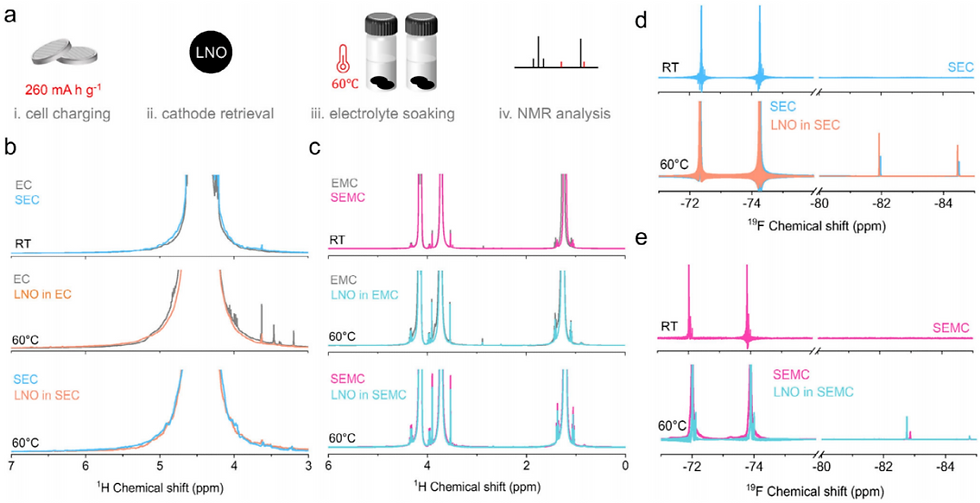

The Catalytic Role of the Lithium Salt: The lithium salt (LiPF₆) and its decomposition products can further accelerate the decomposition of the solvents, exacerbating the entire side reaction process.
Effective Suppression Strategies: Material Doping and Electrolyte Optimization
Based on this deep mechanistic understanding, the study also verified effective strategies for suppressing these side reactions. It was found that elemental doping of the cathode material can significantly improve its structural stability.
Among the options, Magnesium (Mg) doping was identified as a highly effective solution. Mg²⁺ ions, when incorporated into the cathode's crystal lattice, act to stabilize the structure. This effectively suppresses the release of lattice oxygen, thereby mitigating harmful side reactions at their source. Experimental data showed that the Mg-doped cathode exhibited the strongest gas suppression capability across all tested temperatures.
Conclusion and Outlook: Toward High-Stability, High-Energy Batteries
The core contribution of this work is its systematic establishment of the quantitative relationship between the gaseous, soluble, and solid triphasic side reaction products in high-nickel batteries.

This achievement provides critical guidance for battery design:
Battery degradation is a complex process driven by the combined effects of all three product phases, requiring comprehensive solutions.
Suppressing side reactions must be addressed from two angles simultaneously: stabilizing the cathode structure and optimizing the electrolyte formulation.
The analytical methods and mechanistic understanding established in this study will greatly advance the rational design of cathode materials and electrolytes for the next generation of long-life, high-safety, high-energy-density lithium-ion batteries.
Source Information:
Chen Liu, Seth Reed, and Arumugam Manthiram, Delineating the Triphasic Side Reaction Products in High-Energy Density Lithium-Ion Batteries, Adv. Mater., https://doi.org/10.1002/adma.202509889


Comments