

Bypassing Swelling and Dead Lithium: IOP CAS Team Breaks the Energy-Stress Trade-off in Anode-Free Lithium-Metal Batteries

Introduction: The Swelling and Decay Threat in AF-LMBs
Anode-free lithium-metal batteries (AF-LMBs) eliminate traditional graphite anodes, allowing lithium ions to deposit directly onto the copper current collector during charging. While this design maximizes energy density, it brings fatal challenges: the continuous accumulation of irreversible "dead lithium" and solid electrolyte interphase (SEI) during cycling.
In practical pouch cells, these byproducts cause irreversible volume expansion. Under mechanical constraints, this expansion translates into immense internal stress, which compresses pore channels, impedes ion transport, and can even induce dendrite-driven short circuits, posing severe safety risks.
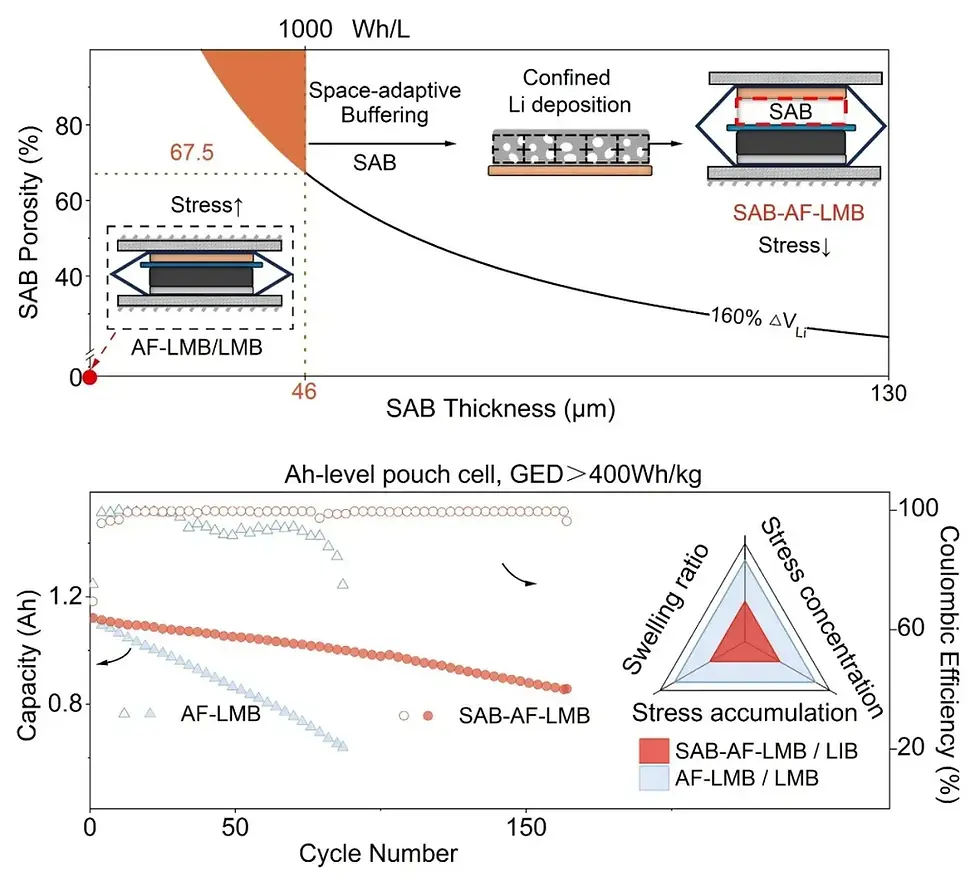
A research team led by Prof. Liumin Suo at the Institute of Physics, Chinese Academy of Sciences, published two back-to-back studies (eScience Energy and Advanced Materials). They established the first quantitative model correlating "expansion evolution—lithium reversibility—cycle life" and innovatively proposed a "Space-Adaptive Buffer (SAB)" design, successfully breaking the impossible triangle of high energy density and low stress in ampere-hour (Ah) pouch cells.

Breakthrough 1 (Quantitative Mechanism): Reading the Cell's "Breath"
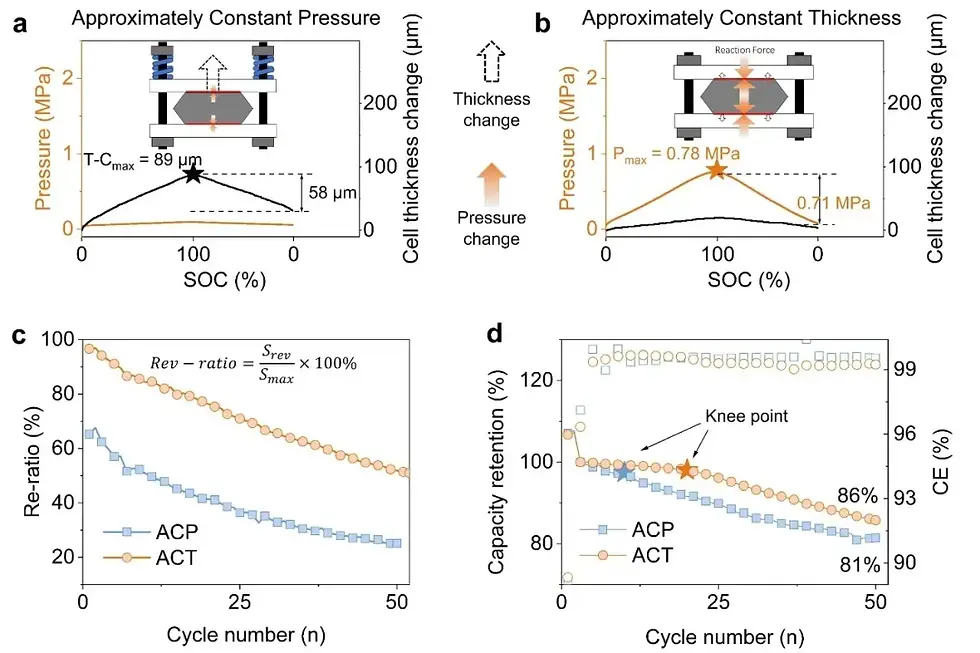
To solve expansion, one must first quantify it. The team developed in-situ expansion and pressure monitoring techniques, decoupling cell expansion into: maximum expansion (Smax), irreversible expansion (Sir), and reversible expansion (Sre). Crucially, they introduced a core descriptor: Reversible Expansion Ratio (Re-ratio = Sre/Smax).
A higher Re-ratio indicates highly reversible lithium stripping. Conversely, a low Re-ratio signals accelerated accumulation of dead lithium and SEI. By comparing mechanical constraint modes, they found:
Constraint Mode | Mechanism | Re-ratio Performance | Impact on Cycle Life |
ACP (Constant Pressure) | Allows free expansion against springs | ~65% initially, dropping rapidly to 23% | Loose Li deposition, more dead Li, rapid decay (81%) |
ACT (Constant Thickness) | Rigid fixture restricts thickness, converting to internal pressure | Up to 96% initially, sustaining 56% at cycle 50 | Moderate constraint promotes dense deposition, higher retention (86%) |
Based on this diagnosis, the team identified optimal operating conditions ("0.3 MPa ACT constraint + slow charge/fast discharge"), enabling a 450 Wh/kg pouch cell to cycle stably for 150 rounds.
Breakthrough 2 (Structural Remodeling): Space-Adaptive Buffer (SAB)
While operation optimization mitigates the issue, intrinsic expansion persists. In multi-layer pouch cells, late-stage global stress can soar to six times that of traditional Li-ion batteries.
To tackle the root cause, the team proposed the Space-Adaptive Buffer (SAB). The core design rule requires providing reserved space equivalent to at least 160% of the theoretical dense lithium volume without sacrificing energy density (demanding high porosity, low thickness, and low true density).
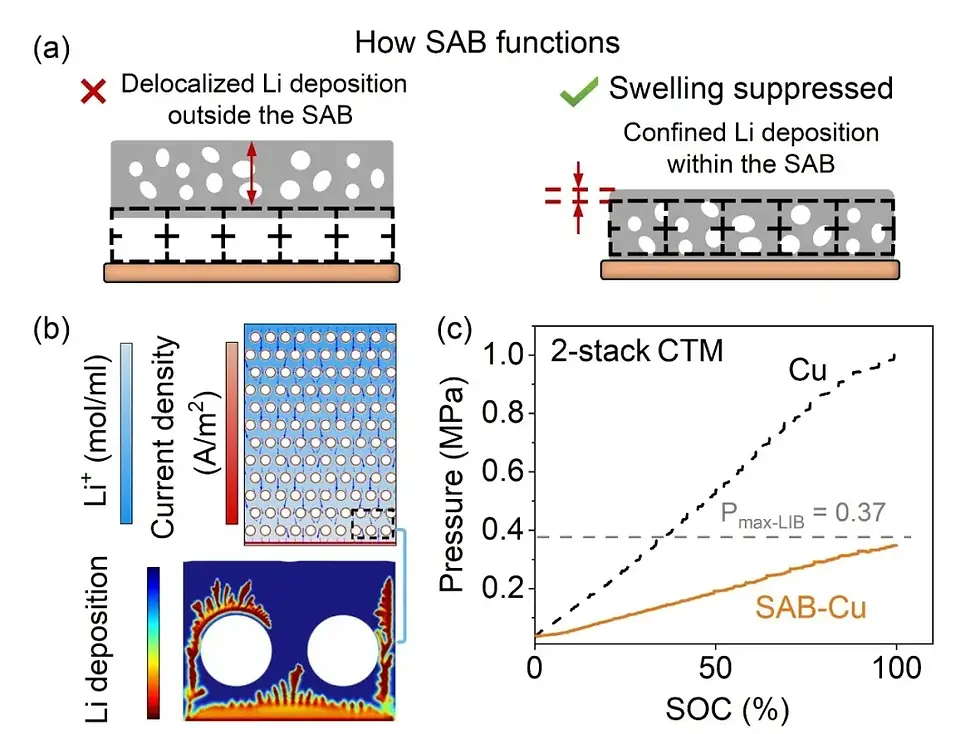
Pore-Filling Deposition: The SAB-Cu structure utilizes lithiophilic induction sites and a 3D pore network to guide lithium to deposit securely inside the buffer layer from the bottom up, rather than growing uncontrollably on the surface.
Stress Reduction & Homogenization: The SAB acts as a robust sponge, keeping overall cell stress increments below 2 MPa. More importantly, it vastly reduces local stress concentration (pressure variance differs by ~6 times), completely preventing local dendrite puncture and short circuits.




Ah-Scale Validation: Synergy of Low Swelling and High Energy Density
The advantages of the SAB structure were comprehensively validated in 16-layer Ah-level pouch cells:
Ultra-High Energy System: Based on high-loading NCM9 cathodes, the SAB-AF-LMB achieved an ultra-high bare-cell energy density of 465 Wh/kg and 1330 Wh/L.
Minimal Expansion: In the Li1.2NCM811 system (418 Wh/kg), the cell retained 77% capacity after 164 cycles. Initial stress accumulation plummeted from 2.2 MPa (control) to just 0.4 MPa, and the expansion rate post-cycling was merely 3.6% (vs. 28% for the control), approaching acceptable limits for commercial LIBs.

Conclusion
From deciphering the code of cell swelling (Re-ratio) to creatively engineering a "bottom-up pore-filling" buffer space (SAB), the team established a complete "mechanism analysis to engineering regulation" loop. They successfully unlocked the stress shackles of anode-free batteries under realistic pouch cell conditions, paving a highly feasible path for the commercialization of next-generation high-energy-density batteries.
Literature Information
Kun Qin, et al., Correlating volume expansion and cycle life in anode-free lithium-metal pouch cells, eScience Energy (2026). https://doi.org/10.1016/j.esen.2026.100076
Kun Qin, et al., Breaking Energy Density-stress Trade-off in Anode-free Lithium Pouch Cells, Advanced Materials (2026). https://doi.org/10.1002/adma.73652


Comments